
Structured human–AI collaboration is becoming essential as AI adoption accelerates.
However, acceleration alone is not the same as progress.
Anyone who has worked extensively with large language models knows the feeling:
- The conversation starts strong.
- Insights multiply.
- Options proliferate.
- Context expands.
- And then…
Something begins to drift.
Not because the model is unintelligent.
Not because the human lacks clarity.
But because nothing in the environment preserves alignment.
When humans and AI systems co-create, two constraints inevitably appear:
- Cognitive load
- Trust continuity
If those constraints are not addressed, they compound.
What began as productive exploration slowly becomes dispersion.
When Collaboration Drifts
In most AI-mediated collaboration environments, attention is fluid but unanchored.
Large language models operate through probabilistic attention mechanisms — an architecture first described in Attention Is All You Need (Vaswani et al., 2017).
Each prompt shifts context.
Each response introduces new structure.
But nothing binds the conversation to a stable problem frame or persistent artifact.
The result looks like a locally coherent but globally drifting system:

Left side: Human prompt → expanding AI responses → branching divergence → fading coherence.
Drift does not happen all at once.
Instead it unfolds gradually:
- The problem statement mutates.
- Hypotheses multiply without selection.
- Measures disappear.
- Context scrolls out of view.
- Reasoning becomes implicit rather than traceable.
The conversation may still feel productive.
But it is metabolically inefficient.
Energy is expended.
Little is preserved.
What is missing is not intelligence.
It is structure.
What FlowFrame Changes
FlowFrame does not attempt to make AI “smarter.”
FlowFrame is a model for structured human–AI collaboration.
It does something more subtle:
It constrains attention.
FlowFrame introduces three stabilizing elements:
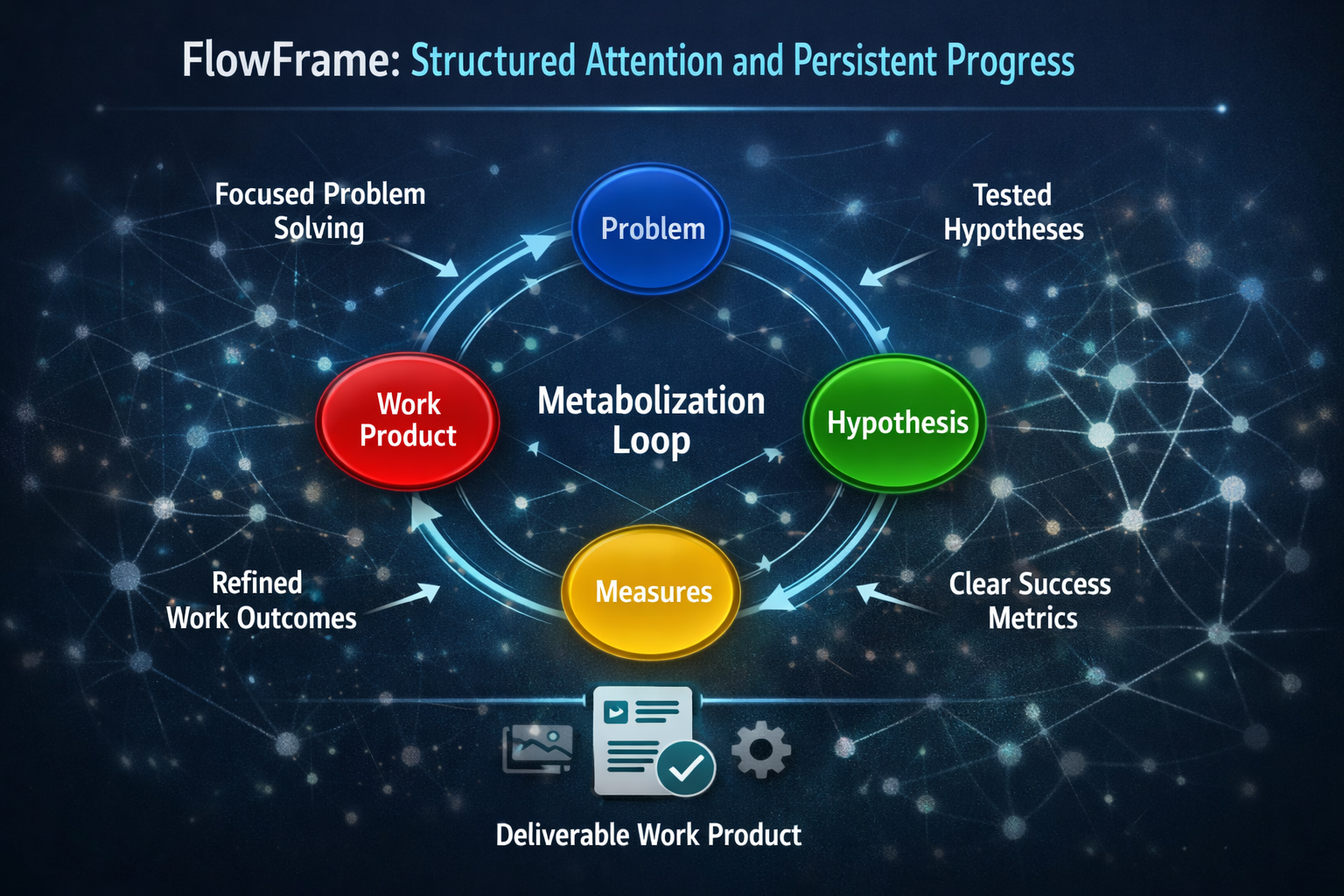
- Frame — Anchored around problem, hypothesis, and success measures.
- Flow — Context-sensitive navigation among those anchors.
- Persistence — Structured capture of reasoning and artifacts.
Together, these transform dialogue from drift into disciplined iteration.
The same conversation — same human, same model — now behaves differently.

Right side: Anchored loop (Problem ↔ Hypothesis ↔ Measures) with Work Product at center and persistent record accumulating.
Notice what changes:
- The problem remains visible.
- Hypotheses are tested, not merely generated.
- Measures guide refinement.
- A work product accumulates.
- Reasoning is preserved.
Drift becomes convergence.
Exploration becomes metabolized learning.
Conversation becomes an asset.
From Response Generation to Structured Human–AI Collaboration
In traditional chat environments:
- Outputs are transient.
- Context is ephemeral.
- Learning is accidental.
In a structured collaboration model (i.e. FlowFrame):
- Every loop produces a work product.
- Every decision has visible rationale.
- Every artifact seeds the next iteration.
This is not workflow automation.
Instead, it is structured attention management.
FlowFrame turns:
- Response speed → Rhythm of reasoning
- Data accumulation → Attention architecture
- Chat history → Organizational memory
As a result, collaboration becomes cumulative rather than disposable.
Why Structured Human–AI Collaboration Matters for Strategy Managers
Strategy managers do not suffer from lack of ideas.
They suffer from:
- Too many parallel threads
- Uncaptured reasoning
- Loss of continuity between sessions
- Cognitive fatigue
The drift problem is not just a user-interface inconvenience.
It is a governance problem.
When reasoning is not structured, decisions become harder to justify, audit, and improve.
Without structure:
- Trust erodes.
- Context fragments.
- Decisions become difficult to defend.
FlowFrame reframes human–AI collaboration as accountable problem resolution.
Each metabolization loop includes:
- A clear problem statement
- A testable hypothesis of improvement
- Explicit success measures
- A defined work product
This simple structure changes everything.
Because now:
- Attention is anchored.
- Reasoning remains visible.
- Learning becomes cumulative.
Drift Detection and Loop Health
Once structure exists, drift becomes detectable.
Healthy loops exhibit:
- Stable tempo
- Clear hypothesis refinement
- Explicit measures
- Growing artifacts
Unhealthy loops exhibit:
- Rapid branching
- Hypothesis churn
- Measure disappearance
- Artifact stagnation
Importantly, FlowFrame does not eliminate exploration.
It metabolizes it.
The Shift
The promise of AI is not unlimited generation.
It is disciplined co-creation.
The difference between the two is visible in the graphics above:
Left: Acceleration without constraint.
Right: Acceleration with persistence.
FlowFrame is not a rigid system.
It is an instrument.
And instruments do not eliminate freedom.
They make performance possible.
If you’re interested in the mechanics of why models drift in standard chat interfaces, see our earlier post on ChatGPT drift.