
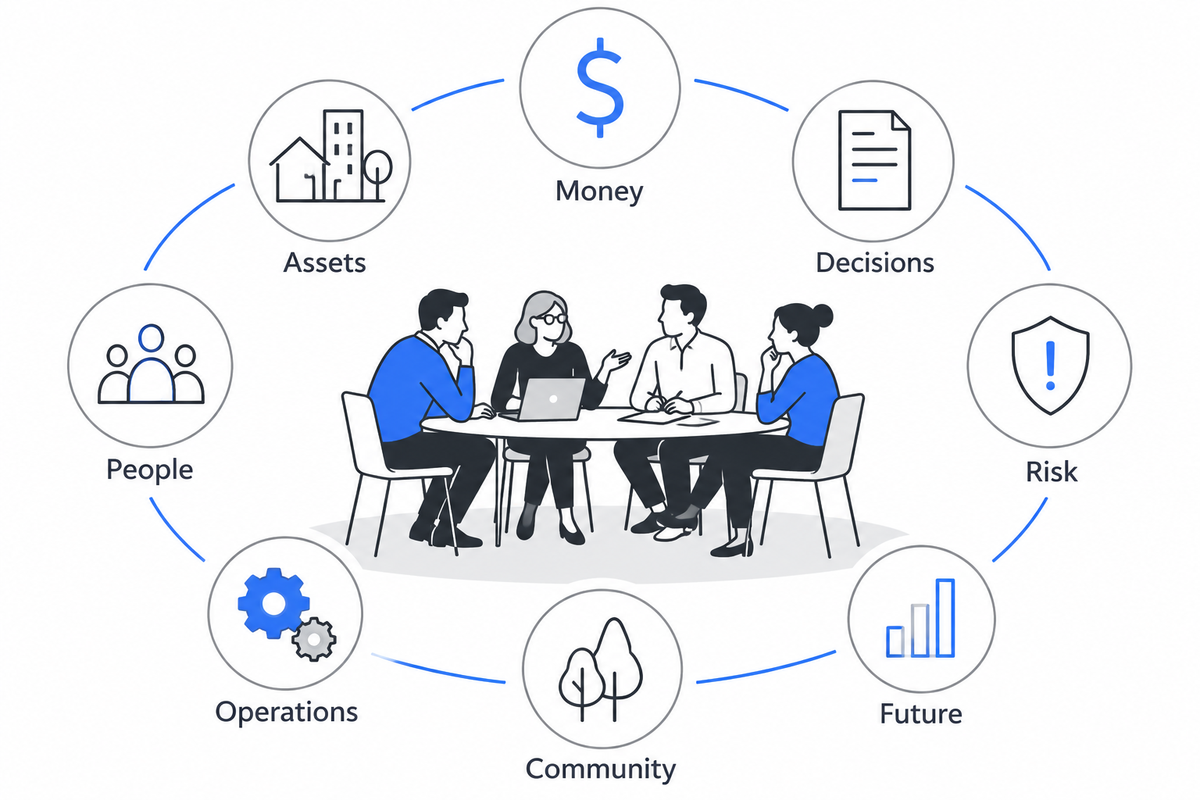
Running a small or mid-sized organization doesn’t mean dealing with small problems.
Complex organizational problems often begin with ordinary questions. A financial result is different from what was expected. A persistent operating expense doesn’t make sense. A new opportunity raises questions the organization has never had to answer before.
Large organizations can assign these problems to finance, operations, compliance or outside consultants.
Small and mid-sized organizations often have a handful of people wearing several of those hats.
The challenge isn’t simply a shortage of money or people. It’s a shortage of time, attention, analytical capacity and institutional memory.
We’ve been examining this challenge in a particularly useful laboratory: homeowner associations, where small volunteer boards routinely face organizational problems that would draw on specialized resources in a larger organization.
What if we could give those people greater problem-solving capacity without making the organization more dependent on any one individual?
Who Manages Strategy in a Small Organization?
Every organization needs someone who connects day-to-day problems and emerging opportunities to its broader objectives.
We call this function the Strategy Manager.
The person doing this work may not have “strategy” anywhere in their title.
It might be an owner, executive director, department head or volunteer board member. What makes that person a Strategy Manager isn’t the title. It’s the role they play when an operational problem requires them to look beyond the immediate task.
They have to understand what is happening, determine what information matters, decide what to do and consider what else may be affected.
And they often have to do that while managing everything else.
This is one place where AI has the potential to change the economics of problem solving for smaller organizations.
But access to more analytical capacity doesn’t by itself provide a method for using it.
A Model for Working the Problem
Corybant was founded in 1992 around a simple idea: strategy becomes actionable when it can be translated into structured problem resolution.
The Corybant Problem Resolution Model (CPRM) provides a way to do that.
An inquiry begins with four basic elements:
- Problem: What are we trying to understand or improve?
- Solution hypothesis: What do we think might make things better?
- Measures: How will we recognize progress or success?
- Work products: What tangible output will help us investigate, demonstrate or implement improvement?
But CPRM isn’t intended to be a rigid sequence.
What we learn while working the problem feeds back into our understanding of it. Evidence may challenge the hypothesis. A work product may expose a missing requirement. What appeared to be the problem may turn out to be a symptom of something else.
We call that metabolization.
The model evolves as understanding improves.

The Corybant Problem Resolution Model™ provides the underlying discipline for an evolving inquiry. Evidence and stakeholder needs feed back into the model, potentially changing the problem itself.
Hypothesis-driven problem solving isn’t new. The thing that matters in CPRM is that stakeholder needs are integral to the inquiry, and even the problem itself can change.
What we learn is metabolized—fed back into the model.
So What Happens When We Add AI?
CPRM predates today’s generative AI by decades.
AI changes something important: the amount of analytical capacity available to the Strategy Manager.
A person working with AI can examine documents, compare evidence, explore alternative explanations and develop work products at a scale that would previously have required considerably more time or additional people.
AI-generated analysis still has to be verified, and organizational information has to be handled with appropriate confidentiality and access controls.
But that creates another problem.
An investigation that lasts weeks or months may span many conversations, documents and decisions. As understanding changes, it becomes increasingly difficult to preserve not just what was decided, but why.
AI can increase our capacity to think through a problem. But without structure and continuity, each new interaction risks becoming another isolated conversation.
That is the problem we are addressing with FlowFrame.
Introducing FlowFrame
FlowFrame is an instrument for applying CPRM to sustained human-AI collaboration.
Its purpose is not to replace the Strategy Manager. It helps the Strategy Manager maintain the structure and continuity of an evolving inquiry while taking advantage of AI’s analytical capacity.
Three elements are central:
Frame anchors the purpose and boundaries of the inquiry.
Flow allows the inquiry to move as evidence changes our understanding.
Persistence preserves reasoning, decisions and work products so that what is learned can become an organizational asset rather than disappearing with the conversation.

FlowFrame combines structure, adaptive navigation and persistence to turn human–AI collaboration into a continuous process of problem resolution.
A good problem-solving process shouldn’t force us to continue solving the problem we originally thought we had.
It should help us recognize when we have learned enough to ask a better question.
Human Judgment Still Matters
AI can help find patterns, compare evidence and challenge assumptions.
It cannot assume responsibility for the organization.
The Strategy Manager still decides what matters, evaluates whether the evidence is credible and determines what action is appropriate. AI-generated analysis still has to be verified, and organizational information has to be handled with appropriate confidentiality and access controls.
FlowFrame makes that human-AI collaboration more structured and traceable while keeping judgment with the human, not the machine.
That is especially important in small and mid-sized organizations, where the person making a decision may also be the person who discovered the problem, gathered the evidence and will ultimately live with the consequences.
A Small Laboratory for Big Problems
We’ve been exploring this approach in an unlikely setting: homeowner associations.
HOAs are small organizations made up of homeowner-stakeholders and typically governed by a small volunteer board of people who live in the community. Yet those volunteers may be responsible for substantial budgets, physical assets, regulatory compliance and long-term capital decisions.
They have a personal stake in the outcome, but generally don’t have finance departments, analysts or project teams standing behind them.
That makes an HOA an interesting laboratory for the problem we’re exploring: what happens when people with significant organizational responsibilities gain access to analytical capacity that their organization could never otherwise afford?
The problems themselves are surprisingly familiar.
- A significant budget-to-actual variance can prompt a simple question about what is behind the number, and lead to a broader inquiry into financial reporting and oversight.
- A recurring operating expense can begin as a search for greater efficiency and cost savings, only for new evidence years later to reveal that the assumptions underlying the expense were wrong—and that the organization was paying for something it should not have been paying for at all. The inquiry then shifts from reducing the expense to understanding and correcting the underlying problem.
- An external change can create an opportunity that existing rules and practices never anticipated, forcing the organization to understand its constraints, stakeholders and options before deciding whether to act.
These aren’t uniquely HOA problems.
A business might encounter the same dynamics through a new technology, an unexpected change in demand or a new partnership opportunity.
The particulars change. The management challenge doesn’t.
Every Inquiry Should Leave Something Behind
A central principle of FlowFrame is that the value of an inquiry doesn’t depend entirely on whether the original hypothesis proves correct.
Every iteration should leave something useful behind.
It may clarify a requirement. Eliminate an incorrect assumption. Produce an analysis that can be reused. Or preserve the reasoning behind a decision so the next person doesn’t have to reconstruct it.
We describe this as turning human-AI dialogue into durable knowledge and sustainable action. Each metabolization loop links the problem, hypothesis, measure and work product so that learning can accumulate rather than disappear.

Each metabolization loop produces evidence, reasoning or a work product that can inform the next iteration and contribute to organizational knowledge.
That becomes particularly important in small and mid-sized organizations.
People change. Volunteers rotate off boards. Managers and vendors leave.
Persistence preserves reasoning, decisions and work products so that what is learned can become part of the organization’s knowledge rather than disappearing with the conversation.
From Problem Resolution to Strategy
None of the HOA examples we’re going to examine began as a “strategy project.”
They began with ordinary questions:
- Why is this number different from what we expected?
- Why does this keep costing so much?
- Is this new opportunity worth pursuing?
But as evidence accumulated, each immediate question led to others. What began as an operational problem or opportunity required a broader understanding of the organization, its assumptions and the systems behind the issue.
That’s the transition we’re interested in.
Problem resolution can become strategy when solving today’s problem improves the organization’s ability to understand and manage tomorrow’s.
The cases that follow show what this looks like in practice—including where an inquiry changed direction as new evidence emerged.
We’ll start where many investigations begin: something on a financial report doesn’t look the way you expected.
You ask why.
What happens when the answer leads to more questions?
The challenge is to follow those questions without losing what you learn along the way—so that solving one problem can strengthen the organization’s knowledge and governance.
What problem are you trying to solve?
What problem or opportunity is taking more time, attention or resources than your organization has available? Tell us about it in the comments.
Leave a Reply