
Most case studies describe what was built.
This FlowFrame case study shows how a blog rewrite became a learning system through metabolization loops and structured AI collaboration.
What began as a straightforward request — “Can we tell the Pumpco story in a way that reflects FlowFrame?” — quietly became a live demonstration of how metabolization loops turn iteration into accumulated learning.
This post reflects on that process.
It extends the original Pumpco case study by making its learning structure explicit — showing how a blog rewrite became a learning system in practice.
The Starting Point of This FlowFrame Case Study
The initial problem was deceptively simple:
How do we position the Pumpco case so it helps people understand FlowFrame as an instrument for learning — not just as a framework or method?
The materials already existed.
The history was well documented.
The outcome was successful.
But something was missing.
The story explained what Corybant built for Pumpco — but not how learning accumulated, how decisions compounded, or how strategy managers navigated uncertainty over time.
That gap became the real problem.
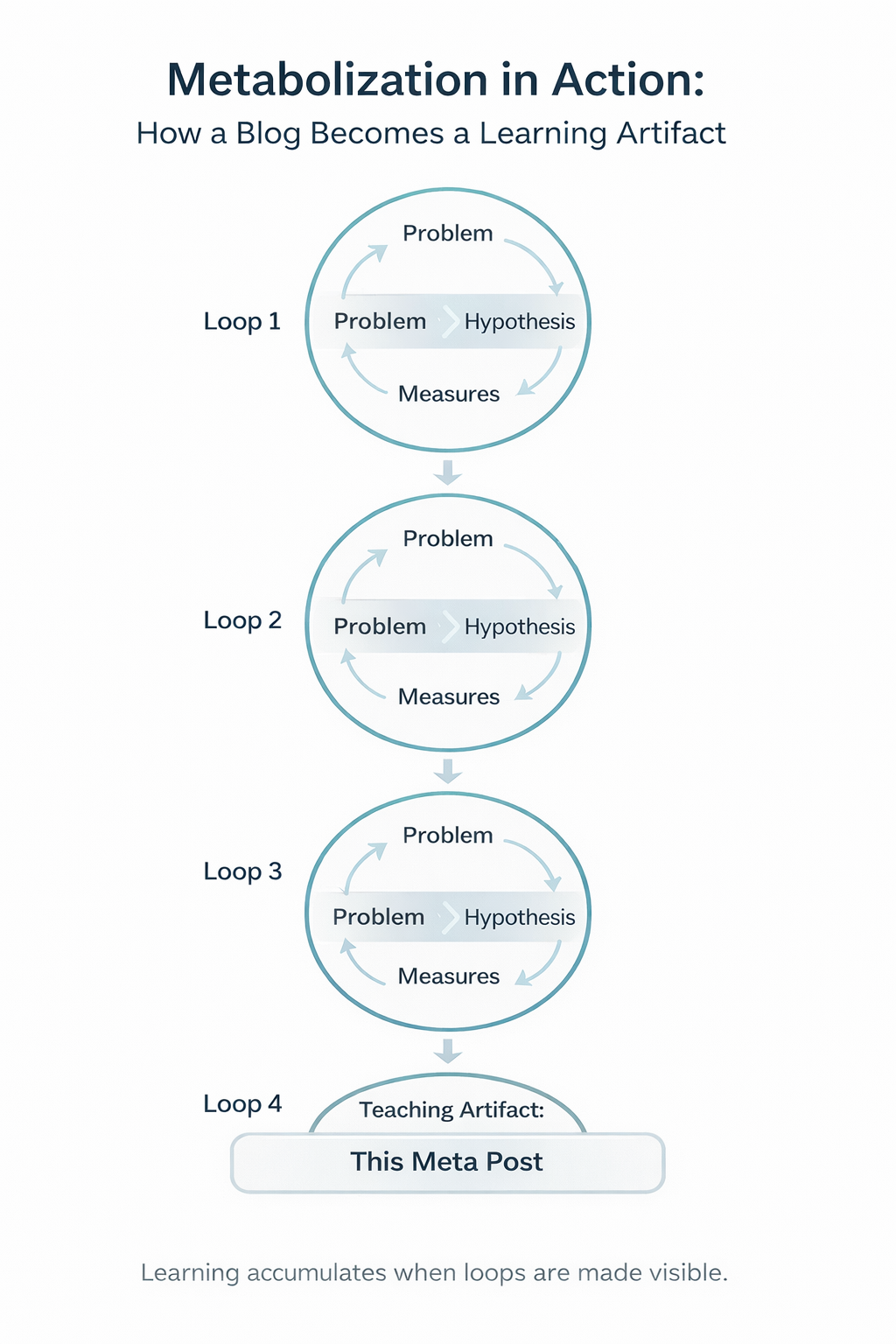
Loop 1: Framing the Problem
Problem
The Pumpco case materials described systems, timelines, and outcomes — but they did not explicitly show learning as an accumulating asset.
Hypothesis
If we reframed the Pumpco case study through FlowFrame’s four anchors — Problem, Hypothesis, Measures, Work Product — we could surface the learning structure that had always been there.
Success Measures
- A narrative that reads as a story, not a technical report
- Clear parallels between AIM and FlowFrame
- Improved readability and audience comprehension
- Stronger alignment with AI strategy conversations
Work Product
A rewritten blog post that reframed the Pumpco story as a FlowFrame case study about learning systems.
This first loop produced clarity — but it also revealed new friction.
Loop 2: Testing the Narrative in the Real World
Once the post landed in WordPress, a different system responded: Yoast.
SEO warnings. Readability flags. Passive voice alerts. Missing keyphrases.
None of these were editorial failures. They were feedback signals.
Instead of treating them as nuisances, we treated them as measures.
Problem
The narrative worked for human readers — but not yet for search engines or scanning audiences.
Hypothesis
If we adjusted structure, phrasing, and emphasis — without changing meaning — we could preserve narrative integrity and improve discoverability.
Success Measures
- Yoast SEO indicators turning green
- Reduced passive voice
- Stronger introductions and subheadings
- Clear focus keyphrase usage
Work Products
- Revised sentences rewritten into active voice
- A refined SEO title, slug, meta description, and excerpt
- Structured subheadings aligned to FlowFrame concepts
This loop didn’t just improve the post.
It made visible how FlowFrame treats constraints as design inputs — not obstacles.
Iteration became accumulation.
Loop 3: Making Learning Visible with Images
Words alone were no longer enough.
The next problem surfaced naturally:
How do we show learning accumulating over time — without diagrams that feel technical, futuristic, or abstract?
Problem
Existing images explained systems, not learning.
Hypothesis
A minimalist visual showing repeated FlowFrame metabolization loops stacking over time would make learning tangible and intuitive.
Success Measures
- A featured image that works for executives, not engineers
- Visual clarity without AI clichés
- Direct alignment with FlowFrame’s four anchors
- Reusable value for future AI strategy content
Work Products
- A custom illustration showing repeated Problem–Hypothesis–Measures–Work Product loops
- Alt-text and captions reinforcing the FlowFrame case study keyphrase
- A reusable teaching image for future posts
At this point, the blog post had become more than content.
It had become evidence of learning.
Loop 4: Reflection Turns This FlowFrame Case Study into Meta-Learning
Only after the post stabilized did a deeper realization emerge:
This entire collaboration had unfolded through FlowFrame metabolization loops — naturally, without enforcement.
We hadn’t imposed structure.
We had discovered it.
In effect, this FlowFrame case study was no longer about Pumpco alone. It had become a demonstration of structured learning in action.

The conversation that produced this blog followed the same structure it describes — loop by loop.
That insight triggered the final loop.
What began as a request to rewrite a case study had quietly become a demonstration of how understanding compounds.
Problem
FlowFrame was demonstrated implicitly, but not named explicitly.
Hypothesis
If we reflected on the collaboration itself, we could create a meta case that teaches FlowFrame by example.
Success Measures
- Clear identification of multiple metabolization loops
- A teaching artifact others can reuse
- A bridge between theory and lived experience
- Strong alignment with AI strategy and learning system discourse
Work Product
This FlowFrame case study.
The artifact now explains not only what was built — but how understanding accumulated.
What This FlowFrame Case Study Reveals About Learning Systems
This process highlights what FlowFrame actually does:
- It reduces cognitive load by forcing clarity at each loop
- It preserves trust by making reasoning visible
- It turns iteration into accumulation, not churn
- It treats artifacts as evidence of learning, not just outputs
- It enables structured human-AI collaboration without surrendering judgment
Most importantly, FlowFrame does not require you to “switch modes.”
It simply names — and stabilizes — the way disciplined strategy managers already think.
Why the Pumpco Case Study Still Matters
Pumpco happened before ChatGPT.
Before FlowFrame had a name.
Before “AI collaboration” was a category.
Yet the learning structure was already there.
That is the point.
FlowFrame is not a reaction to AI.
It is the formalization of a discipline that worked long before AI accelerated everything.
The difference now is that we can finally see it, teach it, and scale it.
Closing Thought
Every good piece of work leaves behind more than an outcome.
It leaves behind understanding.
This FlowFrame case study is not just about Pumpco. It is a record of how understanding itself was built — loop by loop.
Read more about metabolization loops and FlowFrame.
That is what makes a blog post a learning system.
That is FlowFrame.