
When Corybant first began working with Pumpco, no one was talking about large language models, AI copilots, or training intelligence. There was no ChatGPT. There was no FlowFrame. What there was—very clearly—was a company growing faster than its ability to see itself.

This Pumpco case study looks back at how Corybant helped a growing company build learning systems long before AI—and how that experience later shaped FlowFrame.
Pumpco had expanded through acquisition. Sixteen independent operators, spread across multiple states, each brought their own way of working. Loans, utilization covenants, and board-level scrutiny constrained assets worth tens of millions of dollars. The CFO wasn’t asking for dashboards because dashboards were fashionable. He was asking a more basic question:
Do we actually understand how this business is working—and can we prove it?

This post revisits the Pumpco case study to show how Corybant’s early work with learning systems directly shaped the design of FlowFrame—and why that connection matters now.
What Looked Like a Data Warehouse Project
At first glance, the answer seemed straightforward.
Centralize reporting.
Build a data warehouse.
Produce consolidated views.
That was the language of the time—and on paper, that is what the project was.
However, that description misses what really happened.
In the beginning, the early work focused on visibility. Data arrived from the field in spreadsheets and emails. Staff re-entered it manually. Executives spent hours reconciling numbers before meetings with banks and directors. The first step was simply to make that pain go away.
Within weeks, the team automated consolidated reports. Within months, leaders trusted them.
As a result, something interesting happened: the reports didn’t just answer questions—they provoked them.
- Why were similar assets being used so differently in different locations?
- Why were certain pumps idle while others were overbooked?
- Why did pricing, authorization, and sales practices vary so widely across the company?
Each answer led naturally to the next question.
When the System Began to Teach the Business

Over time, the project quietly shifted.
The system was no longer just reporting on the business. It was teaching the business about itself.
Using Corybant’s patented Active Information Model (AIM), implemented through the IVEENA Service Delivery Platform, each enhancement embedded a little more understanding into daily operations.
Policies became explicit.
Workflows became predictable.
Decisions that once lived only in someone’s head became visible and repeatable.
In practice, the work unfolded incrementally rather than all at once. Each step paid for itself. Each improvement reduced friction rather than adding it. Most importantly, human judgment remained in control—but it was now supported by structure.
In hindsight, three things were really being built at Pumpco:
- Visibility across acquisitions
- Consistency in decision-making
- Organizational memory that outlasted individuals
Over time, the organization became more disciplined, more consistent, and more predictable. Asset utilization improved. Financing terms changed. Strategy conversations moved from “What happened?” to “What should we do next?”
Pumpco didn’t just get a system. It gained operational memory.
Pumpco Case Study: Looking Back Through a FlowFrame Lens

Years later, as Corybant began developing FlowFrame, something felt familiar.
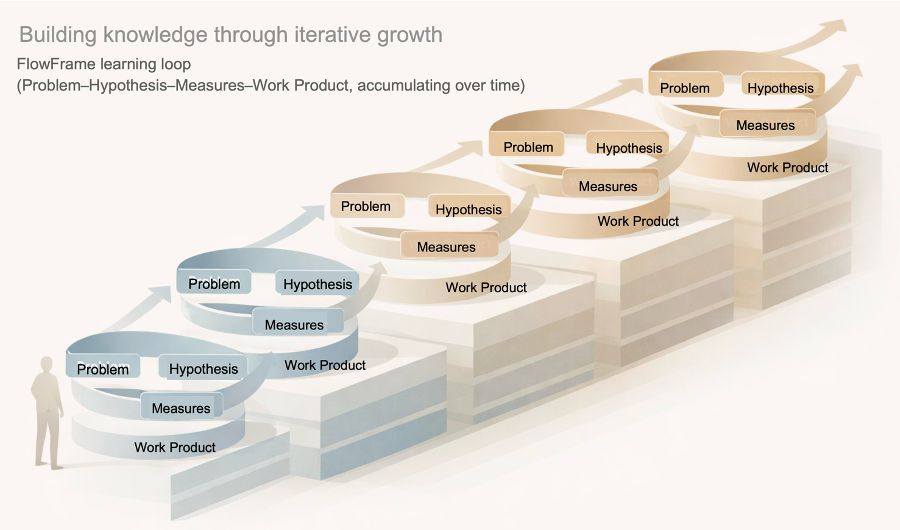
FlowFrame is often described as a way to structure human–AI collaboration. It frames problems, surfaces hypotheses, ties learning to measures, and persists work products so that reasoning doesn’t evaporate at the end of a conversation. It is explicitly designed to reduce cognitive load while preserving trust and accountability.
Seen in that light, the Pumpco case study reads differently.
As a result, AIM, as implemented in IVEENA, was effectively training the enterprise—teaching it how to behave coherently across complexity. FlowFrame applies the same discipline at a different layer.
Instead of training operations, FlowFrame trains how intelligence reasons about strategy.
The parallel is striking:
- Pumpco accumulated operational learning through use
- FlowFrame accumulates cognitive learning through iterative loops
- Pumpco preserved decisions in systems
- FlowFrame preserves decisions in reasoning artifacts
In both cases, improvement wasn’t bolted on after the fact. It emerged naturally from the way work was done.
Why This Case Study Still Matters

It is easy to think of AI as something entirely new. In many ways it is. But the deeper challenge—how to turn human judgment into something durable, explainable, and improvable—is not new at all.
The Pumpco case study shows that Corybant has been solving that problem for a long time.
FlowFrame didn’t appear out of nowhere. It is the continuation of a pattern: building instruments that allow learning to compound without displacing the people responsible for decisions.
Where AIM trained organizations to operate better, FlowFrame trains intelligence—human and AI together—to reason better.
A Note on Confidentiality
Corybant takes customer confidentiality seriously. We do not share client information unless:
- the customer has explicitly agreed,
- the project is already public, or
- the engagement is no longer subject to non-disclosure.
In this case, Pumpco was sold, the systems described are no longer in active use, and the information is not relevant to any ongoing business operations. The materials referenced here are drawn from historical project documentation and publicly shareable case study content.
The Thread That Connects It All
Pumpco was never just about pumps, data, or reports. It was about learning—learning fast enough to keep up with growth, and learning in a way that left the organization stronger after each step.
That same thread runs through FlowFrame today.
Different era. Different tools.
Same belief:
The real asset isn’t the system—it’s what the system learns, and how that learning persists.